
The Connect Framework
System-thinking infused strategic partnerships putting humans at the center of everything we do.
Some call it unconventional. I call it: Use whatever works to transform organizations and humans.
Together, we acknowledge that organizations are complex living systems. And then, we create interventions that irritate. To help you evolve and keep the most important good in your organization: your agency.
Just at the edge of the comfort zone.
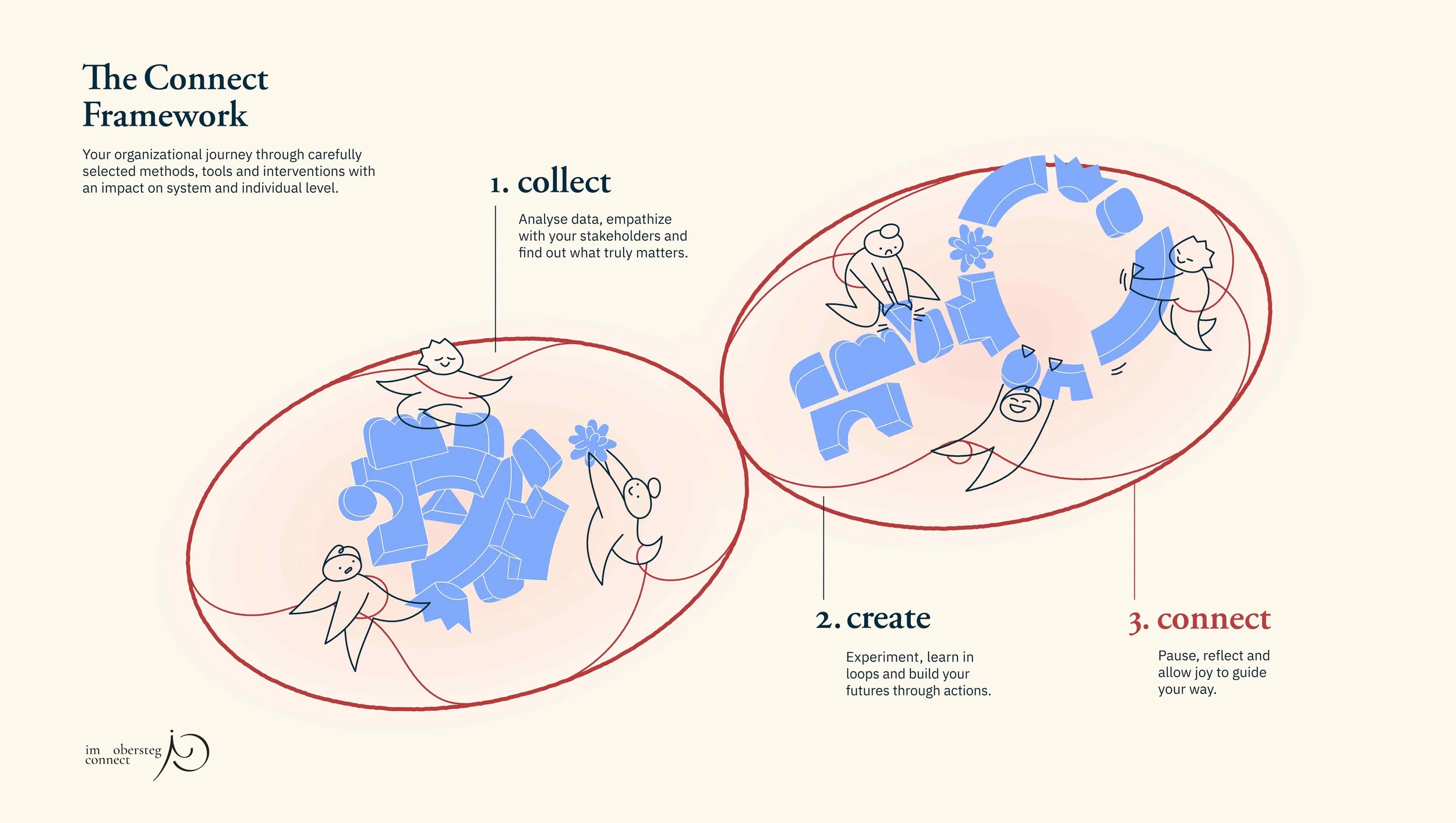
The three continuously and sometimes simultaneously used process steps:
collect
We start by listening. To the data, yes, and to what might be the unsaid in a room. We use spreadsheets and emotions as equally relevant input at this stage.
create
Then we move, by experimenting, building, and adjusting as we go, always close to your organizational reality to feel the difference immediately.
connect
And throughout it all, we pause. To reflect, to celebrate milestones, and to make sure the journey stays joyful, also in challenging times.
Theory Back-bone
Major works that influence how we work together:
Scharmer Otto (2009): Theory U
Schmid, Bernd (2014): Systemic Organizational Development
Grubendorfer, Christina and Ackermann, Christina (2023): The Real Book of Work
Lafley, A. G. and Martin, Roger L. (2024): Playing to Win
Magic Methods & Tools
Whatever helps us to unlock new behavior:
Design Thinking and Innovation tools
Improv Theater
Silence
Paint, swords, colors, trees…

“Lea moderated a panel discussion for us and held the room perfectly - navigating views from very diverse stakeholders and weaving it into an experience full of depth, joy, and connection. Many participants named it the highlight of the Climate Week 2026.”
— Patrik Brandenberg, Co-Founder & COO, reilo